Cloud vs On-Premise Veterinary PACS: Where Your Imaging Storage Should Live
Where veterinary imaging is stored decides more than most practices expect when they choose a PACS: who can open a study and from where, what happens when the internet or a server fails, who patches and backs up the system, and how the bill is structured. There are three honest answers. Studies can live on a server in the practice, in the cloud, or in both at once, with a local node caching recent work and the cloud holding the archive. Asteris offers the first two as separate products, Keystone Omni on premise and NewLumen in the cloud, and the third as a deployment option of NewLumen, so this guide is written from experience of running all three rather than from a preference for one.
Key facts
- A PACS (picture archiving and communication system) stores, retrieves and shares diagnostic images: radiography, ultrasound, CT and MRI. The storage location is an architectural choice; the clinical job is the same in each case.
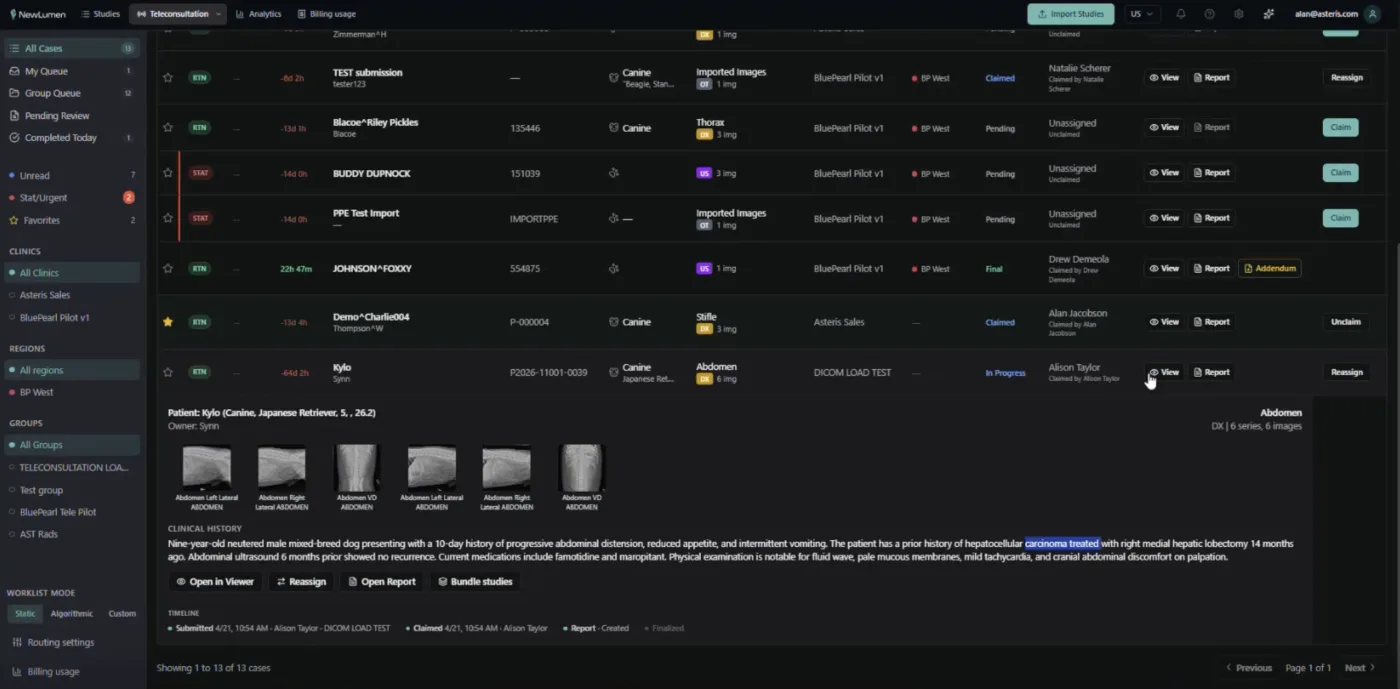
- Cloud veterinary imaging storage means studies are archived in vendor-managed infrastructure and read in a browser from any device, with no PACS server at the practice to buy, patch, back up or replace.
- On-premise PACS keeps the archive on hardware in the practice, which gives local read speed and full offline operation, and puts maintenance, backup and hardware refresh on the practice or its vendor.
- A hybrid deployment, an edge node in NewLumen's terms, is a lightweight local install that caches studies on the practice network so they are viewable in sub-seconds as they stream in, keeps working through an internet or power outage, and spools everything to the cloud in the background.
- Whatever the architecture, the questions that matter are the same: image access, resilience, security and data ownership, and how the cost scales with the practice.
What is a PACS in veterinary medicine?
A PACS receives images from the modalities by DICOM, stores them, presents them in a viewer with the tools a clinician or radiologist needs, and moves them to whoever has to see them next: a colleague, a specialist, a referring practice or a client. Reporting, teleconsultation and integration with the practice management system sit on top of that core.
Three deployments are in common use:
- On-premise PACS. The archive and the viewer software run on servers in the practice.
- Cloud PACS. The archive runs in the vendor's cloud and the viewer runs in the browser.
- Hybrid. A local node holds recent studies for speed and resilience while the cloud holds the archive.
What does cloud storage change for veterinary imaging?
Four things, in practice.
Access. A study is opened from any browser, in the clinic, at home, on a tablet in a consult room or by a radiologist in another state, without a VPN or a workstation install. For a practice that reads for others, or sends out for reads, this is the single largest change: the reading room is wherever the reader is.
Capacity. Storage grows with the archive. There is no disk to fill, no quote for a bigger server, and no decision about which old studies to purge. Cross-sectional imaging makes this concrete: a single CT can run to hundreds of megabytes, and a practice that adds CT to its radiography archive multiplies its storage requirement rather than adding to it.
Maintenance. Patching, backup, encryption and hardware refresh are the vendor's job. The practice keeps the modalities and the network; the archive is somebody else's operational problem, which for a practice without in-house IT is the point.
Cost shape. Cloud PACS is usually paid as an operating cost rather than a capital purchase. NewLumen is priced per case, by modality with study size tiers and volume bands, so the cost tracks the imaging the practice is already charging its clients for.
What does on-premise still do well?
Two things that matter to specific practices.
Local speed and offline operation. With the archive on the local network, a large study opens at LAN speed regardless of the internet connection, and a practice keeps acquiring, viewing and archiving through an outage. For a hospital that images through the night, or a rural practice with an unreliable connection, that is not a minor point.
Control. Data stays on hardware the practice owns, in a building the practice controls. Some organisations, and some IT departments, require that.
Keystone Omni is Asteris's on-premise product and has served that need for two decades. Images are encrypted before being stored locally and in the Asteris cloud, storage is available with no extended service or annual maintenance fees on a pay-as-you-go model, and the archive remains the practice's own data. Practices that want on-premise architecture are not being asked to move; Asteris continues to offer it.
What is a hybrid PACS, and when does it make sense?
Hybrid architecture keeps a local copy for speed and resilience and a cloud copy for access, sharing and disaster recovery. The failure mode it removes is the one that keeps practice owners awake: the internet goes down and imaging stops.
In NewLumen this is the edge node. It is a lightweight Windows install on one machine in the practice. Modalities point at it, images are viewable locally in sub-seconds as they stream in, and the node spools everything to the cloud in the background. If the internet or the power drops, local access continues, and the upload resumes when the connection returns. Every other machine in the practice, including Macs, reads in the browser as normal.
It makes sense for practices doing heavy cross-sectional work, for anyone whose IT department has said no to cloud, and for practices in areas where connectivity is a genuine risk rather than a theoretical one.
How should security and data ownership be compared?
Ask the same four questions of every architecture.
- Encryption. In transit and at rest, and who holds the keys.
- Backup and recovery. How many copies, where, and how long recovery takes after a failure. On premise, this is the practice's plan or its vendor's. In the cloud, it is the vendor's, and it should be written down.
- Access control. Who can log in, from where, and how accounts are provisioned and removed. NewLumen supports single sign-on with SAML, SCIM provisioning and multi-factor authentication, and completes enterprise security reviews on request.
- Ownership and export. Whether the practice can retrieve its complete archive in standard DICOM format if it ever leaves. This should be a plain yes, and it is worth getting in writing regardless of vendor.
Decision guide
- General practice or small specialty practice with no in-house IT. Cloud. Deployment is fast, nothing sits in a cupboard, and reading from home or sharing with a specialist needs no project.
- Referral or specialty hospital doing cross-sectional imaging. Cloud with an edge node. The archive scales with CT and MRI volumes, and the local cache keeps large studies fast and available through outages.
- Practice with strict offline or on-site requirements, or a strong in-house IT team that prefers to own the stack. On premise, with a clear backup and off-site copy plan. Keystone Omni is built for this.
- Teleradiology group reading for many clinics. Cloud. Multi-clinic routing, a single worklist and billing across clinics are only practical when the archive is shared.
Whichever you choose, check DICOM conformance on your modalities first. Cloud storage moves images faster; it does not fix identification tags that were wrong at acquisition.
Frequently asked questions
Is cloud storage safe enough for veterinary imaging?
Yes, when the vendor encrypts data in transit and at rest, keeps multiple copies, controls access with single sign-on and multi-factor authentication, and can show you its recovery plan. Those are the questions to ask; the architecture itself is not the risk.
What happens to a cloud PACS during an internet outage?
With a fully cloud deployment, acquisition queues locally on the modality and viewing waits for the connection. With an edge node, the practice keeps viewing and archiving locally and the node uploads when the connection returns. Practices where outages are a real risk should choose the second.
Can we keep on-premise PACS and still share studies in the cloud?
Yes. Keystone Omni stores encrypted copies locally and in the Asteris cloud, and Keystone Community shares studies with consultants and referring practices without them installing anything. On premise does not have to mean isolated.
How does cloud PACS pricing compare with buying a server?
An on-premise server is a capital purchase with maintenance, backup and eventual replacement on top. Cloud PACS is usually an operating cost. NewLumen is priced per case rather than per seat or per server, so the cost follows the imaging volume the practice is already billing for.
Do we have to choose one architecture forever?
No. Practices move from on premise to cloud when their needs change, and Asteris supports both, so the conversation is about which architecture fits the practice now rather than about switching vendors.
Talk it through on your own numbers
Tell us your modalities, monthly study volume and connectivity, and we will show you what each architecture looks like for your practice, including the cost. Contact the team.