A radiology report turnaround time is the interval between a reading service receiving a study with a complete request and a radiologist returning the report. The figure only tells you something when it is set for each priority, counted from a stated start point and reported as the percentage of cases that met it, so ask a service for those three things before comparing headline numbers.
Where the clock starts and stops
In veterinary teleradiology the clock normally starts when the reading group holds both the images and a request it can act on. Exposure time is the wrong start point, because positioning, repeat views, export from the modality and typing the history all happen inside the practice, and a service cannot be held to a deadline on a study it has not received.
The stop point needs the same precision. It can be a preliminary read, the signed final report, or the moment that report reaches the clinic. A stat promise counted to a phone call is a different promise from one counted to a signed PDF.
Stat, urgent and routine
Most reading groups sort requests into three priorities, and the windows usually fall in these ranges:
- Stat: 1 to 2 hours, for a patient whose treatment tonight depends on the answer.
- Urgent: 4 to 8 hours, for a case that needs a report the same day.
- Routine: 24 to 48 hours, for everything else.
Each group sets its own times, so read the group's own terms. Two details change what the label means in practice. One is who decides that a case qualifies as stat, the sender or the reader. The other is whether the window runs in clock hours or business hours: a routine study sent on a Friday afternoon comes back over the weekend under one definition and during the following week under the other.
What delays a report before a radiologist opens it
Much of the delay on a slow report can arise before any reading starts. The usual causes sit at the sending end:
- The history is missing. Without signalment, clinical signs and the question being asked, the radiologist either reads blind or writes back and waits.
- Views are missing. A thorax sent as one lateral, or an abdomen without the orthogonal view, produces a request for more images in place of a report.
- The patient details are wrong. A study filed under the previous patient's name has to be traced and corrected before anyone can sign against it.
- The study arrives as JPEG. Exported pictures or phone photos of a monitor are not diagnostic quality, and the reader may ask for the DICOM files.
- The request travels by email. A message with attachments has no priority, no owner and no record of when it was seen, so nobody can tell whether a stat case is waiting or being read.
Wet read versus final report
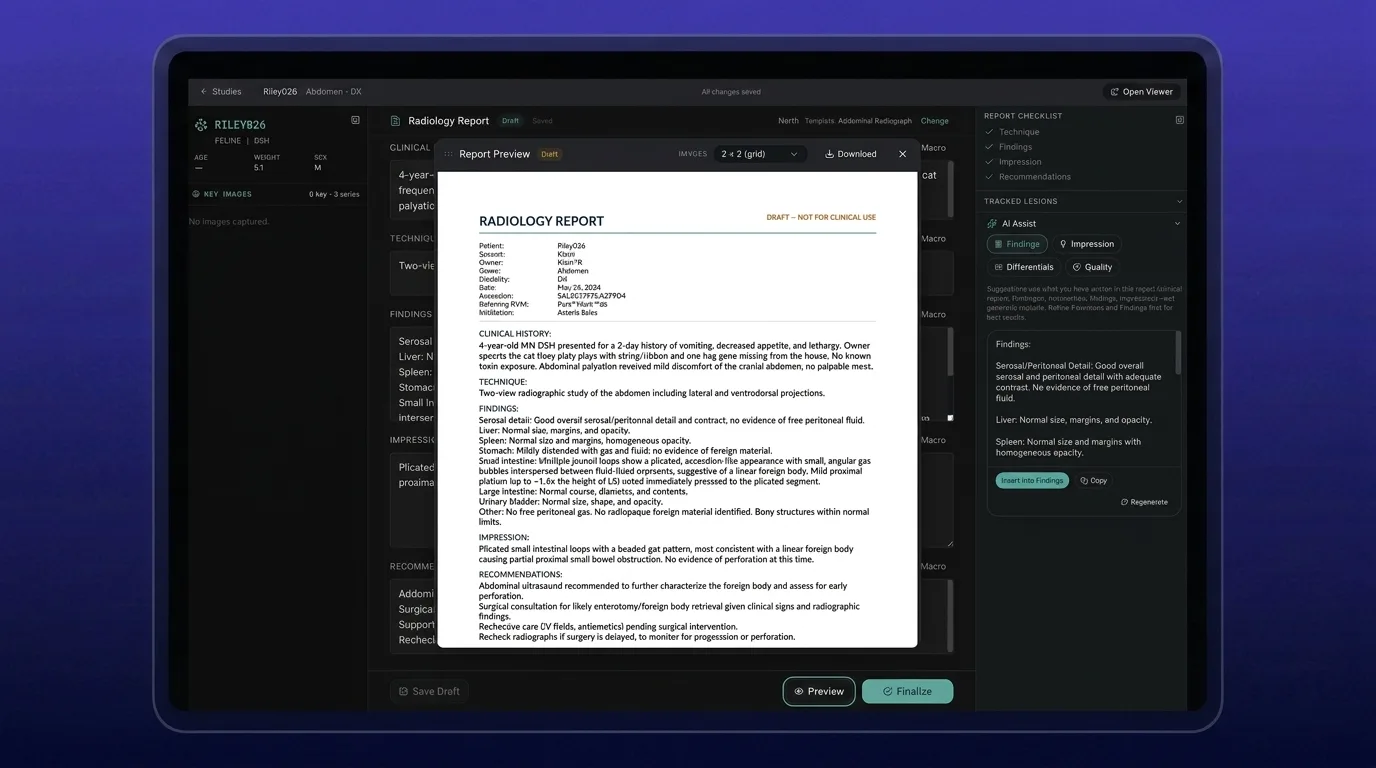
The term wet read comes from film radiography, when a radiologist gave an opinion on a film that was still wet from the processor. It now means a preliminary read: a short interpretation aimed at the immediate clinical question, given by phone or as a brief note so that treatment can proceed. The final report is the full signed document with findings and an impression, it is the version that goes in the medical record, and it can refine or change what the preliminary read said. Our piece on veterinary imaging reporting software covers how that final document is put together.
In a teaching setting, preliminary can also mean a resident's report that waits for a senior radiologist to finalise it. Either way, ask whether the quoted stat time refers to the preliminary read or to the final report.
Median, 95th percentile and percentage within SLA
An SLA, or service level agreement, is the turnaround a group commits to for each priority. Three figures describe how well it is kept. The median is the time by which half the reports were back. The 95th percentile is the time by which 95 of every 100 were back, which shows how slow the slow cases are. The percentage within SLA is the share of cases returned inside the agreed window.
An average hides the bad days. As an illustration only, take ten stat cases where nine are reported in 40 minutes and one takes 6 hours. The average is 72 minutes, comfortably inside a 2 hour window, and the median is 40 minutes. Yet one case in ten missed, compliance is 90%, and for that patient the wait was 6 hours. The percentile and the percentage within SLA expose that case, and the average absorbs it.
A Friday evening stat
Consider a dyspnoeic cat presented at the end of Friday surgery. The cat goes into oxygen, handling is kept to a minimum, and the team takes the thoracic views it can obtain safely. The clinician needs to know whether the pattern fits pleural effusion, pulmonary oedema or lower airway disease, because the next step differs for each.
The times that follow are an illustration. The radiographs are exposed at 18:40. The request reaches the reading group at 19:05, marked stat, with the history and the question. A radiologist phones a preliminary read at 19:30 and signs the final report at 19:55. Counted from receipt to the signed report, the turnaround is 50 minutes. Counted from receipt to the preliminary read, it is 25 minutes. Counted from exposure, which is how the clinician experienced it, the wait was 75 minutes. All three numbers are accurate for the same case, which is why the definition has to come with the figure.
Tracking turnaround in the worklist
NewLumen, the cloud imaging platform from Asteris, puts the priority and the history on the request itself. The clinician sending a case chooses the priority and completes the clinical history and questions, and a request cannot be submitted with required fields empty or with no images attached. The reading group decides which fields are required, so a group that makes the history required will not receive a case without one.
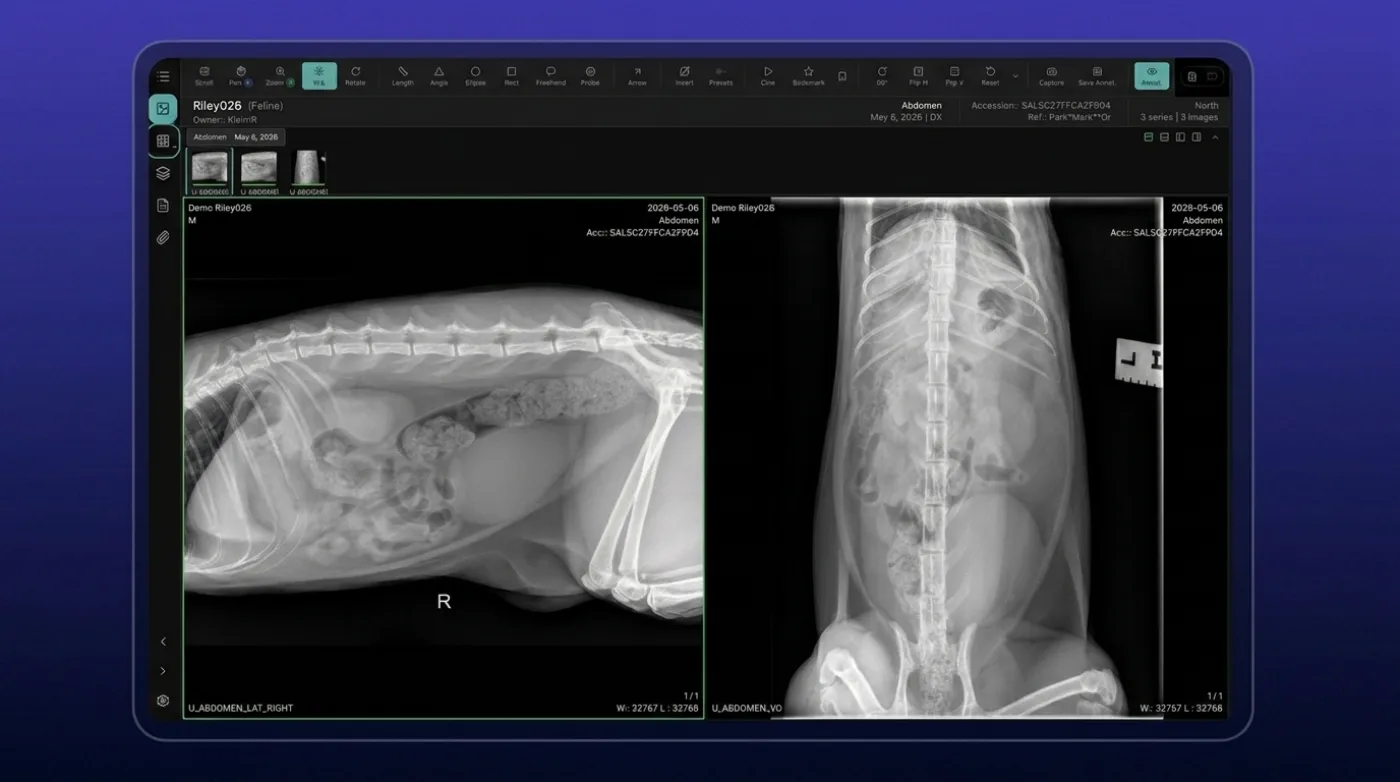
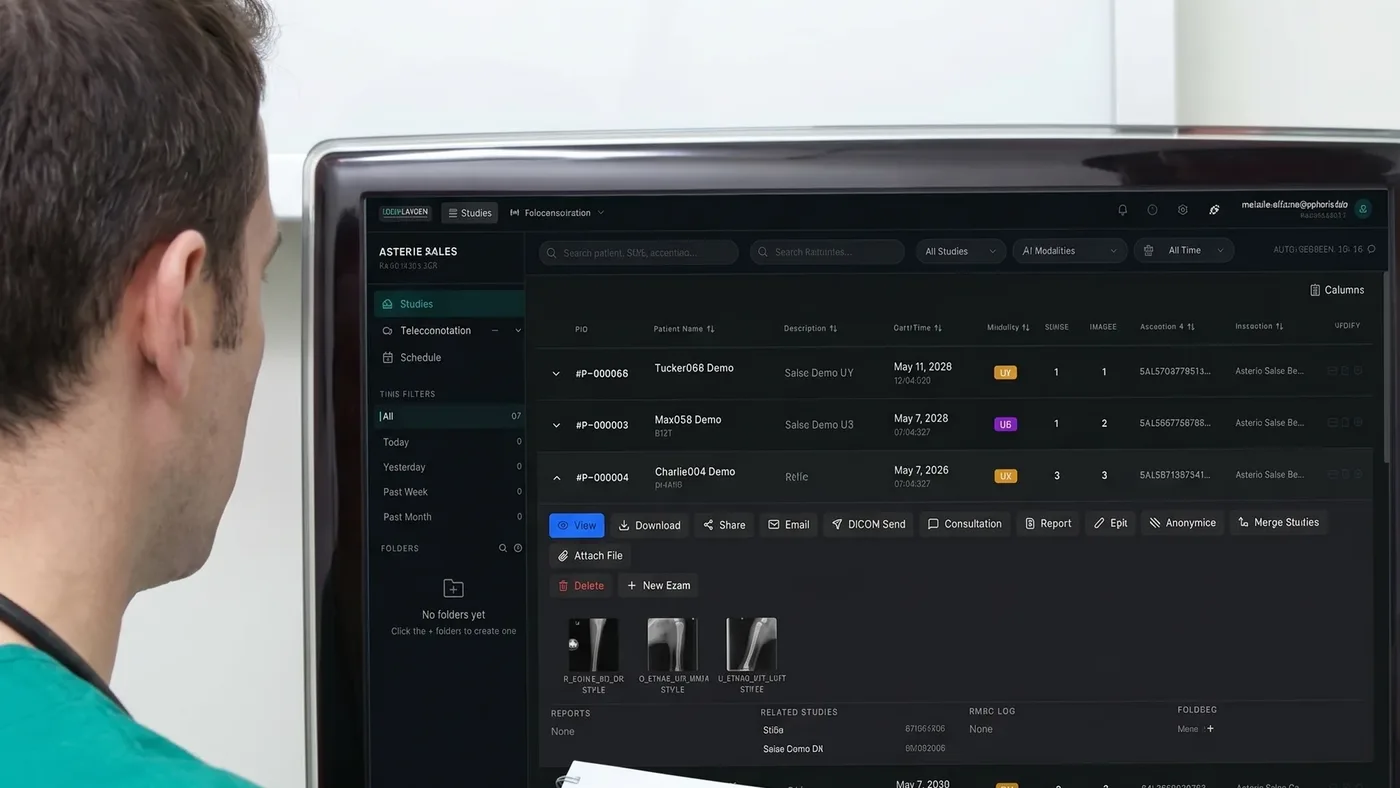
On the reader's side, every case in the worklist shows its priority and an SLA timer. The group sets the turnaround for each priority, and the timer turns from green to yellow as the deadline approaches and red when it is near or has passed. The worklist can show every case, sort cases by priority, or apply custom limits such as only a set number of stat cases at a time. A radiologist claims a case before reading it, which moves it to their own queue so that two readers do not report the same study. Cases can also roll over from one group to another on a time basis, tied to the SLA.
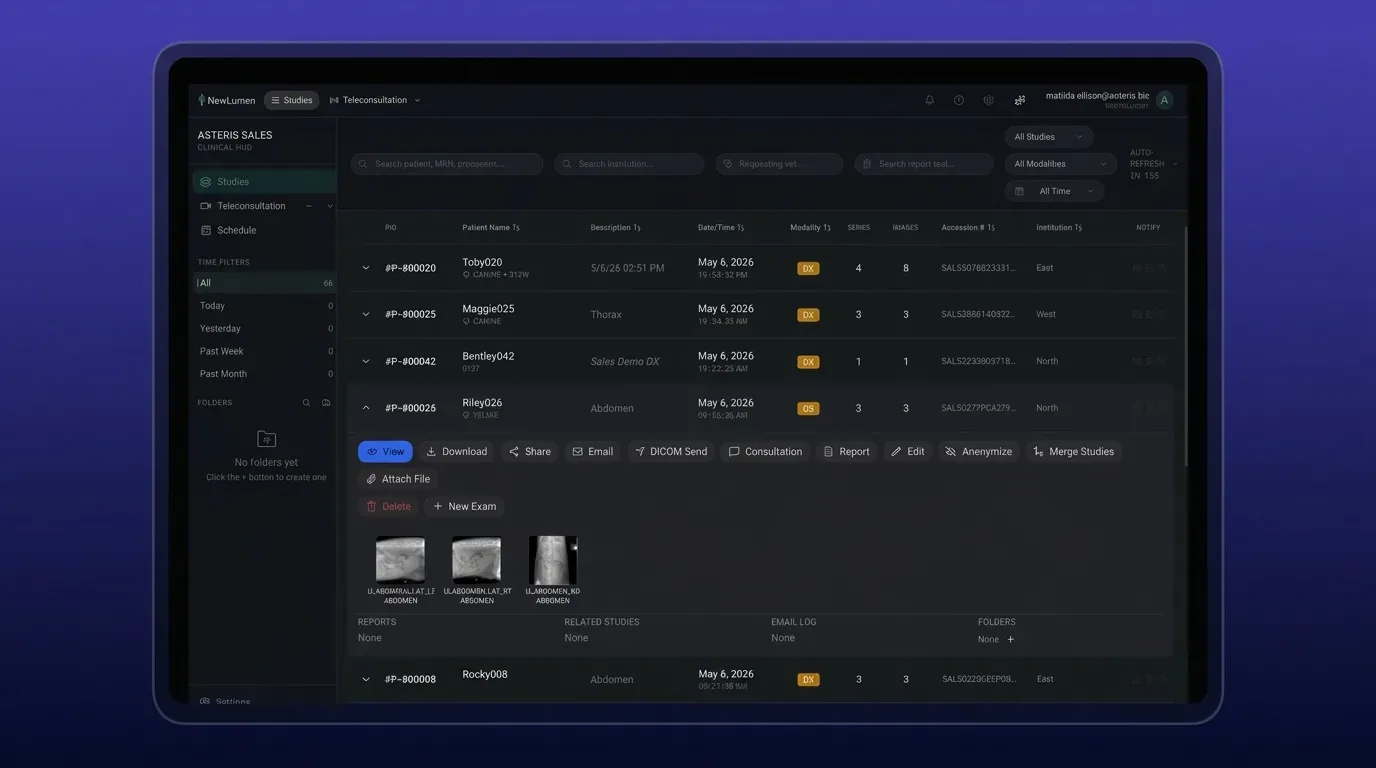
The analytics view reports median and 95th-percentile turnaround, SLA compliance and volume by modality. It filters by clinic, radiologist, modality or urgency and exports to CSV, so a group can hand a referring clinic the figures for that clinic's own cases. The referring clinic sees whether each case is waiting, in progress or complete without phoning the group.
What to ask a reading service, and what a group should publish
Six questions cover most of what a practice needs before it signs up or renews:
- What is the turnaround for each priority, and who decides which cases are stat?
- When does the clock start, and does it pause if you ask us for history or views?
- Does the time stop at a preliminary read or at the signed final report?
- Do the windows run through nights, weekends and public holidays?
- What were your median, 95th percentile and percentage within SLA for each priority last quarter?
- How do we see the status of a case, and what happens to a stat that nobody has picked up?
A reading group can answer most of these in advance by publishing its definitions and its results together: the window for each priority, the start and stop points, the hours covered, and the median, 95th percentile and compliance for a recent period. To see how the timers and turnaround analytics look on your own studies, contact the Asteris team.
Frequently Asked Questions
What is a normal turnaround time for a veterinary radiology report?
Typical windows are 1 to 2 hours for stat cases, 4 to 8 hours for urgent cases and 24 to 48 hours for routine cases. Each reading group sets its own times, so check the group's terms and ask how often each window is met.
When does the turnaround clock start for a teleradiology case?
It normally starts when the reading service has received both the images and a complete request, including the clinical history. It does not start when the images were taken, so time spent acquiring, exporting and submitting the study sits with the practice.
What is the difference between a wet read and a final radiology report?
A wet read, or preliminary read, is a short interpretation given quickly to answer the immediate clinical question, often by phone. The final report is the full signed document with findings and an impression, and it is the version kept in the medical record. Ask a service which of the two its stat time refers to.
Why is average turnaround time a poor measure of a reading service?
An average blends the slow cases into the fast ones, so a service can show a good average while a share of urgent cases arrive late. The median, the 95th percentile and the percentage of cases reported within the agreed window show both the usual performance and the slow cases.
What slows down a veterinary teleradiology report?
The common causes arise before a radiologist opens the study: missing clinical history, missing views, wrong patient details, images sent as JPEG in place of DICOM, and requests sent by email with no tracking. A complete request with DICOM images and a clear question removes most of that delay.