Blog

Vet AI Radiology Accuracy: What the 2026 JAVMA Study Found

Reading Time: 4 minutes–> AI promises to read a radiograph in seconds, and the marketing around it is confident. A common claim is…

share
Published On June 17, 2026
Reading Time: 4 minutes

–>

AI promises to read a radiograph in seconds, and the marketing around it is confident. A common claim is 90% to 95% accuracy. In March 2026, a peer-reviewed study in the Journal of the American Veterinary Medical Association (JAVMA) tested that claim on the kind of films general practices actually take. The results are worth understanding before you let an algorithm have the final say.

The short version

Six commercial veterinary AI radiology tools were tested against real, diagnosis-confirmed cases. On the cases that matter most, they missed a meaningful share of true findings. The takeaway from this study, and the ones cited against it, is the same: AI is a useful second set of eyes, not a replacement for a radiologist.

The study, in plain terms

A team at Murdoch University in Australia (Ma, Faulkner, Stander, Raisis and Joslyn) ran an external validation of six commercial veterinary radiology AI platforms. They collected canine abdominal radiographs from general practice, 53 dogs in all, each with a confirmed diagnosis verified by surgery, necropsy, CT, ultrasound, cytology, or a documented response to treatment. The films were submitted to the AI tools between September and December 2024.

That confirmed-diagnosis design is the important part. The AI was graded against what was actually wrong with the patient, not against another reader’s opinion. Three of the study’s authors are board-certified veterinary radiologists.

What they found

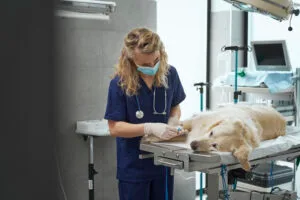
DESCRIBE/CONFIRM: supporting image illustrating veterinary radiograph interpretation

Performance was low to moderate, and it slipped further on the cases that matter most. Because the dataset contained very few normal films, the authors leaned on balanced accuracy and the Matthews correlation coefficient rather than raw accuracy, which can look flattering when most cases fall into one bucket. On the critical small intestinal obstruction cases, balanced accuracy ranged from 53% to 79% and sensitivity from 23% to 69%. In plain terms, the tools missed a meaningful share of real obstructions.

The authors concluded that, as they stand, none of the six platforms were suitable for clinical use on their own. In a follow-up interview, the study’s lead author put real-world accuracy closer to a coin flip than the 90% to 95% in vendor marketing. He also noted something counterintuitive: submitting an extra view can lower an AI’s score, because most systems read each image in isolation, and more images create more chances for the system to contradict itself.

One case that sums it up

A dog had swallowed a river stone, and it had lodged in the small intestine. The team sent two abdominal views to all six platforms. The stone was clearly visible in both films as an oval object in the intestinal region. Two platforms classified the study as normal. A third flagged it as abnormal but never identified the obstruction.

If a tool can miss a stone sitting in plain view, it is not ready to make the call by itself.

“But another study said AI matches radiologists”

It did, and you will see it cited. A 2025 study out of the University of Edinburgh (Ndiaye et al.) found that AI performed almost as well as the best radiologist in the group, across 50 cases scored by eleven board-certified radiologists. Read the detail, though. Its strength was confirming normal films, not catching abnormalities, and it did not offer differential diagnoses.

A published commentary from the Murdoch team flagged a deeper problem. The study lacked a fully independent gold standard, because the AI’s own output was folded into how a “correct” answer was decided, which is circular. In short, the most-quoted “AI is as good as a radiologist” result rests on softer methodology than the general-practice, outcome-confirmed JAVMA study.

What both camps actually agree on

Put the two studies side by side and the same conclusion keeps surfacing. AI complements expert interpretation. It does not replace it. Current tools are better at saying “this looks normal” than at flagging the subtle abnormality, which is exactly the read you most want a specialist for. Even the companies building these platforms say the same thing when pressed: their tools are meant to help a veterinarian decide, not to remove the radiologist from the loop. And the responsibility for acting on a result always stays with the treating veterinarian, not the algorithm.

What this means for your practice

  • Treat AI as triage and a second opinion, not the final word.
  • Keep a board-certified radiologist in the loop for anything ambiguous or abnormal.
  • Remember the duty of care is yours. An AI suggestion that sends a patient to surgery is still your decision to own.
  • Be cautious about platforms that make autonomous AI reads the default, or that lock your studies inside their ecosystem.

Where Keystone fits

DESCRIBE/CONFIRM: veterinarian reviewing imaging at a workstation
Send any study to the radiologist you choose and get an expert read back fast.

Keystone PACS is not an AI-reads subscription. It is the imaging backbone, capture, view, archive and share, that makes the radiologist-in-the-loop model effortless. From the Keystone Omni viewer you can send any study to the specialist you choose, on any device, and get an expert read back fast. Your images, your radiologist, your call.

For the bigger picture on where these tools help and where they fall short, see our companion guide on what AI in veterinary radiology actually does well. If you are newer to the category, start with what a veterinary PACS is.

Sources

  • Ma D, Faulkner JE, Stander N, Raisis A, Joslyn S. Pilot study: external validation of commercial veterinary radiology AI services shows deficiencies in interpretation of general practice-sourced canine abdominal radiographs. JAVMA, March 2026. Read the study
  • Is AI Accurate? A Validation Study on AI Radiology Interpretation (author interview). Today’s Veterinary Practice. Read the interview
  • Veterinary AI radiology tools scrutinized in new study. VIN News. Read the coverage
  • Joslyn S. (interview), AI Radiology for Vets: How Accurate Are Today’s Tools Really? The Vet Vault podcast. Listen
  • Ndiaye YS, et al. Comparison of radiological interpretation made by veterinary radiologists and state-of-the-art commercial AI software. Frontiers in Veterinary Science, 2025. Read the study
  • Joslyn SK, Faulkner J, Ma D, Appleby R. Commentary on the above. Frontiers in Veterinary Science, 2025. Read the commentary

Book a Demo of Keystone Omni Now

Submit images directly through Asteris Keystone or via our free and simple Asteris Keystone Community application.

Subscribe to our newsletter

don't miss out the updates
from asteris

Sign up to our newsletter to stay in the loop.